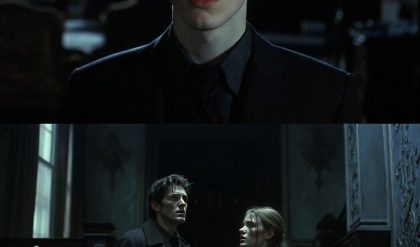
PART 2: THE CHILD WHO LOOKED LIKE HIM
Nathan didn’t understand her at first.
“The photo?” he repeated, as if the word itself had no place in the conversation.
Grace nodded once. “Coney Island. You said you hated that day because it was too loud, too messy, too normal for you to enjoy.”
His expression tightened slightly—because he remembered it. Not the discomfort, but the way she had laughed when a gust of wind knocked his coffee into the sand. The way she had fixed it without complaining. The way he had almost said something he never said to anyone.
Grace continued, quieter now. “I kept it because it was the last time you looked at me like I wasn’t a business decision.”
Nathan’s hand slowly left the glass wall. For the first time since she entered, he looked fully at her—not at the city, not at the contracts, not at the version of himself he performed for the world.
Just her.
“Grace…” he started.
But she shook her head.
“I’m not here to make you feel guilty,” she said. “I’m here because you deserve to know what you threw away before you convince yourself it meant nothing.”
She reached into her coat pocket.
Nathan’s eyes followed the movement instinctively.
When she pulled her hand out, she wasn’t holding another object from their past.
She was holding something he didn’t expect.
A hospital bracelet.
Small. White. Folded slightly at the edges.
His brows furrowed. “What is that?”
Grace hesitated—just long enough for him to feel it.
Then she said it.
“You have a daughter, Nathan.”
The room did not move.
But something inside it collapsed.
He stared at her. “That’s not possible.”
Grace gave a faint, humorless smile. “You were in London when I found out. I tried to tell you three times. Each time, Vanessa was there first.”
His name stopped being a shield at that moment.
“Grace,” he said again, but this time it sounded different. Broken in a way he didn’t recognize.
“She’s three,” Grace continued. “Her name is Lila.”
The air in the penthouse seemed to thin.
Nathan stepped back without realizing it, as if the floor had shifted beneath him. “Why didn’t you—”
“Because you already made your choice,” she interrupted gently. “And I refused to raise a child inside the same sentence you used to justify abandoning me.”
Silence spread between them.
Then, faintly, from the hallway outside the office, a small sound.
A child’s laughter.
Nathan turned.
And everything in him stopped.
A little girl stood just beyond the doorway, held in the arms of a nanny he didn’t recognize. Dark curls. Small fingers wrapped around a toy airplane. Bright eyes scanning the room with the careless curiosity of someone who did not yet understand what power was.
But Nathan understood something else.
Her eyes.
They were his.
Not similar.
Not coincidental.
His.
The world narrowed until nothing existed except that child.
“Grace…” he whispered, but there was no question left in it anymore.
She didn’t answer.
Because she didn’t need to.
The truth was already standing in the doorway.
And for the first time in his life, Nathan Whitmore didn’t look like a man who owned the city.
He looked like a man who had just been undone by it.
Grace picked up her box.
“I won’t stop you from knowing her,” she said softly. “But I won’t let you confuse presence with redemption.”
She turned to leave.
Nathan didn’t move.
Not when she walked past him.
Not when the door opened.
Not even when Lila, curious, tilted her head and said—
“Mommy?”
And then, softly, almost instinctively—
“Who is that man?”
Grace paused at the threshold.
Nathan finally found his voice, but it came out like something new. Something stripped of everything he used to be.
“I’m… someone who was late,” he said.
And for the first time in years, he meant every word of it.