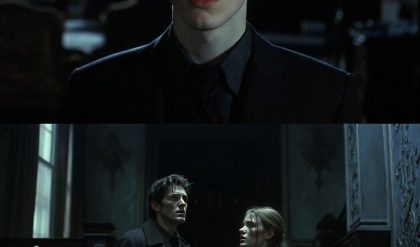
Part 2 — The Boundary I Never Meant to Cross
I told myself the feeling would pass.
By morning, the house was quiet again, the kind of quiet that usually soothed me. I made my tea a little slower than usual, stood a little longer by the window, watched the light fall across Neil’s old roses. Everything looked the same. That was the problem—it was all too ordinary, as if nothing inside me had shifted at all.
Jesse didn’t come by the next day. Or the day after.
And yet I found myself listening for things I had no reason to expect: footsteps on the porch, a knock at the door, the sound of a familiar voice that didn’t belong to my son.
On the third afternoon, it happened again.
Three knocks. Firm. Familiar.
I knew before I reached the door.
Jesse stood there holding nothing this time—no books, no excuse. Just his hands in his pockets and that same careful expression, as if he had rehearsed calmness but wasn’t entirely sure it would hold.
“Hi, Mrs. Caldwell,” he said.
“Jesse,” I replied, too quickly. Then softer, “Come in.”
He hesitated only a second before stepping inside.
We didn’t go to the living room right away. Instead, we stood in the hallway, caught between greeting and something unnamed. The house felt different with him in it again, like it remembered what had happened last time and didn’t know how to behave.
“I wasn’t sure if I should come,” he admitted.
“Then why did you?” I asked before I could stop myself.
That made him look at me directly.
And for a moment, neither of us moved.
“I couldn’t stop thinking about it,” he said quietly.
My breath caught, though I didn’t ask what it meant. I already knew.
The air between us tightened—not uncomfortable, but charged, like the moment before a storm breaks open the sky.
“I’m Paul’s mother,” I said, more firmly than I felt.
“I know,” he replied.
That should have ended it.
It didn’t.
We ended up in the kitchen again, because habits are the easiest lies to hide inside. I made tea I didn’t really want. He stood near the counter without sitting. We spoke carefully, like people walking across ice they were afraid to name.
But the silence did most of the talking.
At one point, I reached for a cup and he stepped closer at the same time. Our shoulders brushed. It was nothing. Less than nothing.
And yet my entire body reacted as if it remembered something my mind had never agreed to.
I stepped back immediately.
“I can’t do this,” I said.
Jesse didn’t move. “Do what?”
My voice softened despite myself. “Whatever this is becoming.”
For a long moment, he said nothing. Then he exhaled, slow and uneven.
“I respect you,” he said. “I respect Paul. That hasn’t changed.”
“I know,” I whispered.
But respect wasn’t the only thing in the room anymore.
He looked down at the counter, then back at me. “I should leave.”
This time, I didn’t stop him.
When the door closed behind him, the house fell into a silence so complete it felt heavier than before. I stood in the kitchen for a long time, staring at nothing, realizing something simple and unsettling:
It wasn’t excitement I had been afraid of.
It was how easily loneliness could disguise itself as connection.
Later that evening, I called Paul. We talked about his conference, about work, about ordinary things that kept the world stable. I listened to his voice and felt the ground return beneath me.
After we hung up, I sat by the window and watched the garden fade into twilight.
And I understood, finally, that some boundaries are not meant to be crossed—not because desire is dangerous, but because some doors, once opened, change the shape of everything behind them.
The next morning, I returned to the roses.
Not to escape anything.
But to remember who I still was.