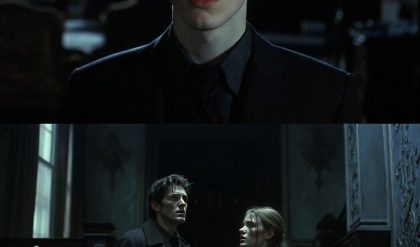
Part 3 — The Price of Knowing
The building was not marked. No signage. No security cameras visible from the street. Just a black glass tower in Midtown that looked like it had been designed to reflect nothing back to the world.
Harper stood in the lobby wearing the only clean shirt she had, the envelope now empty in her hand. The receptionist did not ask her name. She simply pressed a button and nodded toward the elevators as if Harper had always been expected.
On the thirty-second floor, the world changed again.
Men in suits filled a long conference room, their conversations dropping the moment she entered. Adrian was already there, standing at the head of the table, sleeves rolled to his forearms, a city map projected behind him. Red marks dotted several locations across New York like infection points.
“This is her?” someone asked.
“Yes,” Adrian said.
Harper crossed her arms. “I don’t appreciate being discussed like furniture.”
A few of the men exchanged looks.
Adrian didn’t react. “Harper Ellis. Former journalism student. Currently drowning in debt. Recently involved in an incident that disrupted a controlled hit on my associate.”
“Controlled hit?” she repeated.
A man at the table spoke. “Three families are coordinating. They’re moving against Costello operations through civilian intermediaries. People you can’t trace.”
Harper’s stomach tightened. “And you want me to listen to them.”
“I want you to hear what they say when they stop pretending they’re safe,” Adrian said.
“And if I refuse?”
One of the men smiled slightly. “Then you leave. And hope no one remembers you were in the room.”
Harper turned back to Adrian. “You said no consequences.”
“I said I won’t punish you,” he replied. “I didn’t say the world won’t notice you exist.”
Silence fell again, heavier this time.
Then Adrian walked toward her, stopping just close enough that only she could hear him.
“You saved my life,” he said quietly. “Now I’m trying to make sure you don’t lose yours for free.”
For a moment, Harper saw something beneath the control—fatigue, maybe. Or responsibility too large to carry cleanly.
She exhaled. “If I do this, I’m not your weapon.”
“No,” he said. “You’re your own problem.”
That almost made her laugh.
Almost.
Two weeks later, Harper learned the first truth: people lied differently when they thought she didn’t matter.
A banker in a private lounge spoke too freely about shipments that never appeared on paper. A developer joked about “removing obstacles” that had names attached to them. A politician used laughter to disguise instructions that were not meant to be heard outside marble walls.
She wrote everything down.
And Adrian never once told her what to keep.
Only where to stand.
But the more she listened, the more the lines blurred. Between protection and control. Between safety and ownership. Between being used and being trusted too deeply.
One night, she returned to her apartment to find the door already unlocked.
She froze.
Inside, nothing was missing.
Only one thing was added.
A photograph on her table.
Her mother. Alive. In a hospital bed. Paid in full.
And beside it, a note:
Now you’re really in it.
Harper didn’t sleep that night.
Because for the first time, she understood the real cost.
Not the debt.
Not the danger.
But the fact that Adrian Costello had stopped asking her to choose.
And had started making sure she couldn’t leave.