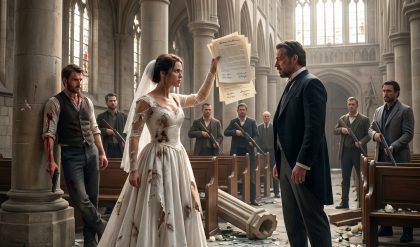
PART 3_She took the envelope, opened it, and removed the cashier’s check. Six hundred thousand dollars. Her name typed cleanly. Their guilt made payable.
Then she tore it in half.
Jack stared.
Tessa tore it again.
The pieces fell between their boots.
“You’re right,” she said. “I was waiting for you to prove I belonged.”
“Tess—”
“But that was my mistake. Not your permission.”
She stepped back.
“Tell Wyatt the next offer comes in court.”
Jack’s face hardened, grief turning into anger because anger was easier to inherit.
“You’ll regret this.”
“I already regret you,” she said.
Then she walked upstairs before her knees could fail.
The hearing was scheduled for Friday morning in a courtroom that smelled like dust, floor wax, and old arguments.
By then, everyone had chosen a side, though most were too polite to name it. The Mercers arrived together: Wyatt in his black hat, Elaine in pearls, Jack in a dark jacket, Aspen Vale beside him with a diamond bracelet bright enough to look like a weapon. Her father, Conrad Vale, sat behind them, silver-haired and still, a man whose money had taught him silence could buy more than shouting.
Tessa arrived with June and Ruby.
Walt came in last.
The room changed when he entered.
Not loudly. No one gasped. But hats shifted. Eyes dropped. A man like Walt did not walk into court against Wyatt Mercer unless something old had cracked under the valley.
Wyatt did not turn around.
He knew.
The temporary injunction hearing should have been narrow: preserve records, prevent transfer, halt the Vale merger pending review. But Wyatt Mercer had never known how to leave a fight narrow. His attorney, a smooth man from Helena named Briggs, painted Tessa as a bitter outsider weaponizing divorce to extort a historic family ranch.
Tessa listened.
Outsider.
Temporary.
Emotional.
Unstable.
Each word had been chosen because it had once worked on her.
June let Briggs speak.
That was one of June’s gifts. She did not interrupt a man building his own gallows.
When her turn came, she stood with one hand resting on Tessa’s file.
“Your Honor,” June said, “my client is not asking the court to decide ownership today. She is asking that the defendants be prevented from destroying evidence, transferring encumbered property, or finalizing a merger based on documents that appear to include forged signatures and fraudulent land representations.”
Briggs stood. “Baseless.”
June lifted one page. “October fourteenth.”
Jack’s head lowered.
Wyatt’s did not.
June called Tessa first.
Tessa walked to the witness stand with her palms damp and her spine straight.
Briggs tried to make her sound foolish.
“You sold an apartment in Denver to invest in a ranch you did not understand, correct?”
“I sold my apartment to help my husband’s family keep their ranch.”
“So you agree you were motivated by emotion.”
“I was motivated by feed bills, bank deadlines, and a man crying in a barn.”
A murmur moved through the room.
Briggs smiled thinly. “You fancied yourself a savior.”
Tessa looked at Jack.
He did not look back.
“No,” she said. “I thought I was a wife.”
Briggs paced. “But you signed documents releasing your interests.”
“I signed some documents. Not that one.”
“You expect this court to believe someone forged your signature in a public filing?”
“I expect this court to compare the date with where I was.”
“And where were you?”
“In Billings, with Walt Graves.”
Briggs glanced toward Walt. “A longtime Mercer employee suddenly willing to support your story.”
Tessa looked at Walt. “Not suddenly.”
Briggs turned. “Mrs. Mercer, isn’t it true you were desperate to be accepted by the Mercer family?”
June’s eyes sharpened.
The judge looked up.
Tessa felt the question enter the room like a snake.
She could deny it.
She could say no, absolutely not, I was strong, I was smart, I was never lonely. She could lie the way pride wanted her to lie.
Instead, she gripped the wooden edge of the stand.
“Yes.”
Jack looked up then.
Tessa did not look away from Briggs.
“Yes,” she repeated. “I wanted them to love me. I wanted a family. That made me trusting. It did not make my signature available.”
The room went quiet.
Briggs sat down sooner than he intended.
Then Walt testified.
His voice shook at first. Then steadied. He gave the receipt. The mileage log. The memory card from the north fence camera. The video showed headlights after midnight, three men moving posts under a moon bright enough to make guilt visible. Jack’s truck. Wyatt’s figure. Walt himself, carrying wire.
Wyatt watched the screen without expression.
Elaine covered her mouth.
Aspen stared at Jack as if seeing the outline of the house he had invited her into.
Then June entered the survey overlay.
Thirty feet.
Enough to alter apparent creek access.
Enough to change the value of the merger.
Enough to turn “family legacy” into land fraud.
Conrad Vale leaned forward for the first time.
The judge granted the injunction.
No transfers. No merger. No destruction of records. Independent forensic review. Survey freeze. Financial accounting.
A small victory.
Small victories did not feel like triumph. They felt like surviving the first wave and seeing the ocean behind it.
Outside the courthouse, reporters from a Billings station waited. Someone had tipped them off. June suspected Ruby. Ruby denied nothing.
Wyatt stopped on the courthouse steps.
Cameras turned.
Tessa stood below him, one step down.
For the first time since she had met him, Wyatt Mercer looked tired.
Not weak.
Never weak.
But tired, as if the land itself had finally asked him for a payment he could not pass to someone else.
“You think you won?” he said softly.
Tessa did not answer.
Wyatt looked out over the street, the diner, the trucks parked along the curb, the town that had lived under his weather for decades.
“My grandfather came here with nothing but two cows and a Bible he couldn’t read,” he said. “My father buried three children in ground too frozen to dig proper. You think land stays in a family because everyone plays nice? It stays because someone is willing to be harder than hunger.”
Tessa hated him.
And still, some part of her understood the shape of the fear beneath his cruelty.
Wyatt turned his eyes back to her.
“You had money and loneliness,” he said. “We had land and debt. Don’t dress it up prettier than it was.”
Jack flinched behind him.
Wyatt stepped closer, lowering his voice so only Tessa and those nearest could hear.
“You want the truth, girl? You didn’t save us because you loved Jack. You saved us because being needed felt close enough to being wanted.”
The words struck so precisely that Tessa forgot the cameras.
For a breath, she was not on the courthouse steps. She was in every room where she had worked too hard to be kept. Every holiday where she brought the perfect dish. Every relationship where she apologized first because silence terrified her more than blame. Every night at the Mercer kitchen table, adding columns while the family slept, building a home out of usefulness.
Wyatt saw it land.
His mouth bent.
A cruel man’s satisfaction. A true thing used as a knife.
Tessa stepped closer.
“You’re right,” she said.
Wyatt’s smile faltered.
“I did confuse being needed with being loved.” Her voice shook, but it held. “That’s mine to answer for.”
She looked past him to Jack.
“But you confused owning land with deserving it.”
Then she turned to the cameras.
“My attorney will be filing for a full accounting and fraud review. Any ranch employee or contractor with information can contact our office confidentially. No one who tells the truth will stand alone.”
Walt bowed his head.
Ruby smiled like a match being struck.
Wyatt’s face darkened. “You don’t have the power to promise that.”
Tessa looked back at him.
“No,” she said. “But I have the money you forgot was mine.”
The story broke wider than anyone expected.
Not because rich families cheating women was new. It was not. Not because a forged signature shocked Montana. It did not shock enough people. The story broke because of the video: the old patriarch, the handsome husband, the midnight fence line, the billionaire neighbor’s pending merger, the wife in the ditch.
The drone footage came from a teenager named Noah Bell who had been filming landscape shots for his school project from the county road. He had caught Tessa walking alone, tiny against the red dirt, suitcase dragging behind her like a stubborn shadow. Then Jack’s truck blasted past, throwing mud and sending her down.
Noah posted it before anyone could scare him out of it.
By Monday, half the state had seen Tessa fall.
By Tuesday, people began asking why no one helped her up.
Shame did what law could not do quickly.
The mechanic fixed Ruby’s freezer for free. The beef supplier called it a misunderstanding. Two former Mercer employees contacted June. Then five. Then twelve. Stories emerged in pieces: unpaid overtime hidden as “family help,” grazing leases altered after handshake agreements, a widow pressured to sell water rights after her husband died.
Wyatt Mercer had not become cruel overnight.
He had simply met someone who kept copies.
Tessa spent those days in motion. Affidavits. Bank statements. Survey maps. Meetings in Ruby’s back room. Calls from reporters she mostly ignored. Calls from Jack she did not answer. Calls from Elaine she blocked after the third voicemail dissolved into weeping accusations about how Tessa was “destroying a family.”
A family.
The word had teeth now.
On Thursday, Aspen Vale came to the diner alone.
Every conversation died when she walked in.
Ruby looked her up and down. “We’re out of whatever rich girls drink when they’re nervous.”
Aspen removed her gloves. “Coffee is fine.”
Ruby poured decaf.
Tessa almost smiled despite herself.
Aspen sat across from her in the back booth without asking.
Tessa closed the folder she had been reading. “If you’re here to tell me Jack loves me in his own way, I’ll save you time. His own way needs liability insurance.”
Aspen’s mouth twitched.
“I’m not here for Jack.”
“No?”
“No.” Aspen looked toward the window, where two men outside suddenly found their truck tires fascinating. “My father is pulling out of the merger.”
Tessa waited.
“He says fraud makes land smell bad.”
“Wise.”
“He also says your claim makes the ranch vulnerable.”
“There it is.”
Aspen looked back. Her eyes were not soft. Tessa respected that more than false sweetness.
“I was raised around men like Wyatt Mercer,” Aspen said. “My father wears better suits, but he counts people the same way. Useful. Risky. Replaceable.”
“And you?”
“I learned to be useful before I could spell it.”
The answer surprised Tessa.
Aspen touched the rim of her untouched mug. “Jack told me your marriage was over.”
“It wasn’t.”
“I know that now.”
“Did you care then?”
Aspen’s jaw tightened.
There. A real question. Not whether Aspen had known facts, but whether she had wanted not to know them.
Aspen inhaled slowly. “Not enough.”
Tessa leaned back.
That was the first honest thing Aspen had given her.
“My father wants to buy your position,” Aspen said. “Not Wyatt’s. Yours.”
Tessa stared.
“He believes the Mercers are finished controlling that ranch. He thinks you may end up with leverage over the secured sections, possibly voting rights if the LLC amendment is voided.”
“And he sent you to ask?”
“No. He told me not to come near you.”
“Then why are you here?”
Aspen looked down at her hands. No rings. Perfect nails.
“Because if my father buys you out, he will strip what he wants and let the rest bleed. If Wyatt keeps it, he’ll punish everyone who spoke. If the bank steps in, the land gets broken into pieces.” She lifted her eyes. “You’re the only person in this mess angry enough to fight and foolish enough to care who gets hurt.”
Tessa did not answer.
Aspen reached into her bag and placed a folder on the table.
“What’s that?”
“Vale due diligence. Appraisals, water studies, private survey notes. Including the original boundary concern my father found before Wyatt moved the fence.”
Tessa did not touch it.
“Why give me this?”
Aspen’s smile was small and bitter. “Because Jack proposed last night.”
The diner went utterly quiet.
Ruby, from behind the counter, whispered, “Oh, honey.”
Aspen did not look away from Tessa. “He used his grandmother’s ring.”
Tessa felt nothing at first.
Then a clean, bright pain.
Elaine had taken that ring from the counter because family jewelry stays with family.
Of course.
Of course they had placed it on Aspen’s hand before the mud on Tessa’s coat fully dried.
But Aspen’s fingers were bare.
Tessa looked at them.
Aspen saw.
“I said no.”
Tessa did not trust herself to speak.
Aspen’s voice lowered. “I am not giving you that folder because I’m kind. I’m giving it because I saw the life they were building for me. Land first. Woman second. Truth nowhere. I may be greedy, Tessa, but I’m not interested in becoming expensive furniture.”
Tessa opened the folder.
The first page was a private survey dated two months before Wyatt moved the fence.
June, reading over Tessa’s shoulder, whispered a word no lady lawyer should have known.
Aspen stood.
At the door, Tessa said, “Aspen.”
She turned.
“Did you love him?”
Aspen looked through the diner window at the mountains beyond town.
“I loved winning,” she said. “Jack was just wearing the medal.”
Then she left.
The climax came not in court, but in the sale barn.
Wyatt forced it there.
The annual Mercer stock auction had been planned long before the scandal, and June advised Tessa to stay away. Too volatile. Too public. Too much room for Wyatt to turn ranch country against the woman who dared air dirty laundry where cattlemen drank coffee.
Tessa agreed.
Then Walt called at dawn.
“They’re selling the north herd,” he said.
Tessa sat up in the motel bed. “The injunction freezes transfers.”
“Wyatt says cattle aren’t land assets. Says he’s liquidating to pay operating debt.”
June, asleep in the other bed with files spread over her chest, opened one eye. “That old bastard.”
Walt’s voice dropped. “That herd was bought with your feed money. Your records prove it. And Tess…”
“What?”
“He’s selling Mercy.”
Tessa closed her eyes.
Mercy was not valuable in the way auction men understood value. A gray mare with a scar along one flank, too old for hard work, too smart to tolerate fools. The first month Tessa lived on the ranch, Mercy had bitten Jack, ignored Wyatt, and followed Tessa across the yard after Tessa whistled three off-key notes from an old lullaby her mother used to hum.
Jack had laughed then. “She only comes for broken things.”
Tessa had fed the mare apple slices all winter.
Mercy had carried her through her first spring storm when she got turned around near the north fence and panicked so badly she forgot which way home was. The mare had ignored the reins and taken her back.
No one gets lost if they can still see the north fence.
Tessa got dressed.
June sat up. “We need a court order.”
“How long?”
“Hours.”
“The auction starts in one.”
“Tessa.”
But Tessa was already pulling on her boots.
Ruby drove like the devil had insulted her biscuits.
The sale barn parking lot was packed when they arrived. Trucks, trailers, men in hats, women with tight mouths, kids eating dust with their candy bars. The air smelled of manure, hay, diesel, and money trying to pretend it was tradition.
Tessa stepped out.
Conversations bent toward her.
She had worn jeans, boots, a white shirt, and the red bandanna tied around her wrist. The bandanna was clean now, though the stain at one corner would never fully wash out. Let it stay, she thought. Some stains were testimony.
Inside, the auctioneer’s chant rolled fast over the crowd. Cattle moved through the ring, restless and shining. Wyatt stood near the front with Jack beside him. Elaine sat stiffly two rows back, eyes red. Conrad Vale stood along the wall, unreadable. Aspen was nowhere.
Wyatt saw Tessa and smiled.
That smile told her he had expected her.
June grabbed Tessa’s arm. “Do not let him provoke you into a public mistake.”
Ruby said, “But if you do, aim well.”
Tessa moved down the aisle.
The auctioneer faltered for half a beat, then continued.
Wyatt tipped his hat. “Tessa.”
“Stop the sale.”
His voice carried just enough. “Ladies and gentlemen, my former daughter-in-law has mistaken a cattle auction for divorce court.”
Laughter, nervous and scattered.
Tessa felt heat rise in her face.
Jack looked at her wrist. At the bandanna. Something moved across his expression and vanished.
June stepped forward. “Mr. Mercer, you are on notice that assets tied to disputed operating funds—”
Wyatt cut her off. “Cattle eat whether lawyers approve or not.”
A few men nodded.
Wyatt turned to the room, voice growing. “You all know me. You know my family. You know what it takes to hold land when banks circle and outsiders smell blood. Now we’ve got a woman who married in, cashed in, and wants to carve up a working ranch because her feelings got bruised.”
The room shifted.
Tessa felt it: the old current, the suspicion of women who brought paper to land fights.
Wyatt pointed toward the pens. “Those cattle don’t belong to hurt feelings. They belong to the Mercer brand.”
Then Jack spoke.
“Dad.”
One word.
Quiet.
Wyatt ignored him.
Tessa looked at Jack.
His face was pale.
The auctioneer waited.
Wyatt stepped closer to Tessa. His voice lowered, but the front rows heard every word. “Walk away while you still look like a victim. Push further, and you’ll become what you really are.”
Tessa whispered, “What’s that?”
Wyatt’s eyes were flat. “A woman who’d rather kill a ranch than admit she was never family.”
The words entered the room and stayed there.
Jack closed his eyes.
Tessa heard her own heartbeat.
This was the moment everything in her wanted to choose fire.
She could destroy him. June had enough. Aspen’s folder. Walt’s video. The forged documents. The moved fence. The threats. The employees. She could take the microphone and turn the room into a blade. She could make every person there watch Wyatt Mercer shrink.
And if she did, the bank would move faster. Buyers would scatter. Workers would go unpaid. The land would fracture. Ruby’s suppliers, Walt’s insurance, Miguel’s rent, the calving crew, the hay contractor — all of them tied to a ranch Wyatt had made too big and too sick to bleed cleanly.
Revenge stood before her, perfect and deserved.
Mercy screamed from the holding pen.
The sound cut through the barn.
Tessa turned.
The gray mare threw her head, fighting the lead rope held by a boy too young to know he was handling someone else’s last straw.
Tessa whistled three notes.
The mare stopped.
Every head in the barn turned.
Mercy’s ears pricked forward.
The boy loosened the rope, startled.
Mercy walked toward Tessa.
Not fast. Not dramatic. Just steady, through dust and noise and the smell of fear, until her scarred head pressed against Tessa’s chest.
Something in the room broke open.
Tessa placed her muddy palm on the mare’s neck.
Then she faced Wyatt.
“No,” she said.
Wyatt frowned.
“I’m not going to kill the ranch.”
June looked at her sharply.
Tessa’s voice strengthened. “You don’t get to make that the choice.”
Wyatt’s face tightened. “You don’t have another.”
“Yes,” Tessa said. “I do.”
She turned to the room.
“My money bought winter feed, replacement stock, veterinary care, and the hay that kept this herd alive. My records prove it. The court will decide what I own. But I’m offering this now, in public, because too many people here work under men who make private threats.”
The barn had gone silent.
Tessa looked at Walt. Miguel. The young boy with the lead rope. Elaine, crying without sound. Jack, standing beside his father like a man finally seeing the fence around his own life.
“I will place any recovered land interest into a worker-managed trust with a conservation restriction preventing sale to Vale Ranch or any outside development group for twenty years.”
Conrad Vale’s eyes narrowed.
Wyatt went white.
June whispered, “Tessa.”
Tessa kept going.
“Operating profits will pay wages, debts, and restitution before owner distributions. Anyone who falsified records can come forward within seventy-two hours through my attorney. Anyone who threatened employees will be named.”
Wyatt stepped toward her. “You stupid girl. You don’t even know what you’re giving away.”
Tessa looked at him.
There it was. The final cost.
Not the money. Not even the ranch.
The fantasy.
The secret dream that one day the land would be hers and everyone would see she had been worthy all along. That the porch would welcome her. That the blue mug would return to the hook. That Jack would understand too late and ache forever.
She let the dream die standing up.
“I know exactly what I’m giving away,” she said. “The need to be chosen by people who only choose what they can use.”
Jack made a sound, small and wounded.
Wyatt turned on him. “Say something.”
Jack looked at his father.
For thirty years, Jack Mercer had been raised to believe love was obedience with a family name attached. He had inherited Wyatt’s fear, Elaine’s silence, and a ranch too heavy for his spine. Tessa saw the boy in him. The coward. The man. All of it.
“Say something,” Wyatt repeated.
Jack removed his hat.
The barn waited.
Jack looked at Tessa. “I signed the merger disclosure knowing the fence line had been altered.”
Wyatt’s face changed.
Jack’s voice shook. “I knew Tessa hadn’t signed the LLC withdrawal. I didn’t forge it.”
Elaine sobbed.
“But I knew,” Jack said. “And I let it stand.”
Wyatt struck him.
The slap cracked through the sale barn.
Jack stumbled but did not fall.
No one moved.
Wyatt’s hand hung in the air, and suddenly every person in that room saw him clearly. Not as legacy. Not as land. As an old man who had mistaken control for strength until he could no longer tell the difference between a son and a gate that would not latch.
June was already on the phone.
Ruby had both hands over her mouth, eyes bright.
Tessa stood with Mercy’s breath warm against her shoulder and felt no triumph.
Only grief.
Huge. Clean. Unavoidable.
The auction was halted.
By sunset, Wyatt Mercer was no longer in control of Mercer Ranch operations.
Not officially forever. Court did not move like thunder. It moved like weathering stone. But emergency orders came fast after Jack’s public admission and Aspen’s documents. A temporary receiver was appointed. Financial accounts were frozen. The disputed cattle stayed. Mercy was loaded not into a buyer’s trailer, but into Walt’s old one, because the receiver agreed she was not to be sold pending ownership review.
Wyatt did not go to jail that night.
Men like Wyatt rarely met consequences at the speed their victims deserved.
But he was escorted out of the sale barn by a deputy half his age while cameras recorded the set of his jaw. He did not look at Tessa as he passed. He looked at the land beyond the parking lot, as if expecting it to rise in his defense.
It did not.
Jack found Tessa near the trailers after dark.
Mercy stood behind her, tearing hay from a net with offended dignity. The sky had turned purple over the mountains. The sale barn lights buzzed. People moved in clusters, speaking softly, retelling what they had seen because truth often needed repetition before it felt real.
Jack stopped a few feet away.
His cheek was red where Wyatt had hit him.
Tessa waited.
“I should’ve said it sooner,” he said.
“Yes.”
“I should’ve stopped him.”
“Yes.”
“I should’ve stopped myself.”
Tessa looked at him then.
That one mattered.
Jack swallowed. “I don’t expect forgiveness.”
“Good.”
He almost smiled. It hurt too much to become real.
“I loved you,” he said.
Tessa looked at Mercy’s lead rope in her hands. “I know.”
“You don’t believe me.”
“I believe you loved me as much as you could without choosing me when it cost you.”
He looked down.
The truth did not need volume.
“I’m going to cooperate,” he said. “With June. With the receiver. With whatever comes.”
“Because it’s right?”
He took too long.
Tessa nodded. “Try again.”
Jack closed his eyes. “Because I can’t keep living inside his voice.”
That, she believed.
Not noble. Not clean. But honest enough to start a different kind of sentence.
He reached into his pocket.
For one wild second, Tessa thought he would bring out the ring.
Instead, he held out the broken spur she had once kept on the kitchen windowsill. It had belonged to Jack’s grandfather, snapped during a storm roundup. Jack had given it to her after their first month on the ranch and said, “This place breaks everything before it trusts it.”
She had thought it romantic then.
Now she saw the warning.
“Mom was going to throw it out,” Jack said. “I thought you might want it.”
Tessa took the spur.
Its edge was dull. Useless. A relic of pain mistaken for proof.
She placed it in the dirt between them.
“No,” she said. “Let it stay broken.”
Jack stared at it.
Then he nodded.
When he walked away, Tessa did not watch until he disappeared.
That night, she slept in Walt’s trailer beside Mercy’s temporary pen because every motel room in town had been taken by reporters, lawyers, and men pretending they were not curious.
Ruby brought blankets. June brought documents. Walt brought an old lantern and a thermos of coffee. Miguel brought a sack of apples for Mercy and did not say much, but when he handed them to Tessa, his eyes were wet.
“You sure about the trust?” June asked after the others left.
Tessa sat on the trailer step, wrapped in a blanket, looking toward the dark outline of the mountains.
“No.”
June sat beside her.
“That is not the answer attorneys prefer.”
“It’s the true one.”
June sighed. “You may recover less personally.”
“I know.”
“You may spend years in litigation.”
“I know.”
“You may save a ranch that will never love you back.”
Tessa smiled faintly. “Wyatt said land doesn’t love anyone.”
“He was right about that.”
“Yes.” Tessa looked at the silver compass in her palm. “But people do. Badly, sometimes. Cowardly. With conditions. With fear. Still, they do.”
June bumped her shoulder gently.
“Your mother would be furious you’re sleeping in a horse trailer.”
Tessa laughed. It surprised her. The sound rose into the cold and came back different.
“She’d say at least the horse is honest.”
“She would.”
For a while, they sat without speaking.
Then Tessa said, “When she died, I thought if I could just become necessary enough, no one else would leave.”
June’s face softened in the lantern light.
“And now?”
Tessa watched Mercy shift in her pen, gray hide silver under the moon.
“Now I think people leave. Or they stay wrong. Or they stay and still hurt you.” She closed her fingers around the compass. “But I don’t have to abandon myself first to make room for them.”
June looked away.
“Damn,” she said. “I hate when clients grow. It complicates billing.”
Tessa laughed again.
This time, it did not break.
The months that followed did not arrange themselves into justice as neatly as strangers online wanted them to.
Wyatt Mercer was charged with fraud, evidence tampering, and conspiracy related to the forged filings and altered fence line. His attorneys called it overreach. His friends called it a tragedy. His enemies called it overdue. Tessa called it Thursday and kept signing paperwork.
Elaine moved into her sister’s house in Bozeman and sent Tessa one letter on cream stationery.
I did not know everything.
Tessa read that line three times.
Then the next.
But I knew enough to be ashamed.
There was no request for forgiveness. That was why Tessa kept the letter.
Jack pled to lesser charges in exchange for cooperation. He lost his management role, his inheritance voting rights pending civil resolution, and most of the town’s easy respect. He got a job hauling feed for a ranch two counties over, where no one cared that he had once been a Mercer except when they cared too much.
Aspen Vale left Montana for six months.
When she returned, she did not marry Jack. She started a land due diligence firm run entirely by women who had learned, one way or another, to read the fine print men slid across tables with smiles. Ruby said that was the most Aspen thing imaginable: turning a moral awakening into a billable service.
Conrad Vale tried twice to buy pieces of the Mercer operation through intermediaries.
The worker trust blocked both.
The trust itself was messy.
Of course it was.
Walt hated meetings. Miguel mistrusted lawyers. Ruby insisted on attending though she owned no cattle and claimed emotional damages from years of bad Mercer tips. June threatened to resign every other week and never did. The receiver drank antacids like candy.
Tessa did not move back into the ranch house.
She could have, eventually. There were legal arguments, symbolic arguments, practical arguments. But the house on the hill still held Elaine’s perfume in the curtains and Wyatt’s shadow in the doorway. Some places did not become home just because the locks changed.
Instead, Tessa took the old foreman’s cottage by the north fence.
It leaned slightly east. The porch boards complained. The kitchen sink dripped unless the handle was turned exactly wrong before it turned right. In winter, wind came through the back door and made the curtains breathe.
Tessa loved it carefully.
Not desperately.
Careful love, she discovered, had room for flaws.
She hung the cracked blue mug from the diner on a hook by the stove. Ruby had given it to her after the first trust meeting, saying, “Every revolution needs bad coffee.” Tessa drank from it on mornings when the frost silvered the grass and the cattle moved like dark thoughts across the pasture.
She kept the red bandanna tied to the north gate.
Not as a Mercer color.
As a warning.
As a witness.
As proof that cloth could survive mud, washing, court exhibits, and still hold.
The silver compass stayed on the windowsill above her desk, beside the first signed trust document. Sometimes, when decisions became difficult, she touched it before answering. Not because it told her where north was. Because it reminded her that north had never been a place someone gave her.
Walt came by most evenings with excuses.
Fence staple.
Weather report.
A question about invoices he absolutely knew how to read now.
One April evening, nearly a year after the ditch, Tessa found him on her porch fixing a board that had not asked to be fixed.
“You know,” she said, leaning in the doorway, “you don’t have to keep repairing things to prove you’re sorry.”
Walt hammered one nail.
Then another.
“Who says I’m sorry?”
“You did. Several times.”
He grunted. “Memory goes at my age.”
She smiled.
He looked up at her then, eyes squinting against the low sun. “Maybe I’m not proving. Maybe I’m staying.”
Tessa’s throat tightened.
She looked toward the north pasture, where Mercy grazed with two younger horses she bullied shamelessly.
“Staying is not the same as making it right,” Tessa said.
“No,” Walt agreed. “But it gives a person time to try.”
That was the kind of apology she could live beside.
Not a grand one.
A daily one.
In late spring, the first community branding under the trust drew more people than anyone expected. Some came to help. Some came to stare. Some came because Ruby threatened to refuse pie service to cowards.
The ranch yard filled with trucks. Kids chased dogs. Smoke rose from the barbecue pit. Miguel organized crews with the calm authority of a man who had always known how things should run and had finally been allowed to say so out loud.
Tessa worked the gate.
Dust coated her jeans. Sweat stuck hair to her neck. Her knee still ached in cold weather from the fall, but it held. Her hands moved with practiced certainty now: latch, swing, count, release.
Near noon, a truck rolled up the drive.
Jack stepped out.
Conversation thinned.
He wore old work clothes and no hat. That detail mattered. Men removed hats in church, court, and grief. Jack carried his like he had not decided which one this was.
Tessa walked to meet him before anyone else could turn the moment into theater.
“Jack.”
“Tessa.”
He looked thinner. Older. Less polished by certainty.
“I’m not here to cause trouble,” he said.
“Then don’t.”
A brief smile touched his mouth. “Ruby said if I wanted to apologize, I should bring labor.”
“Ruby has strong theology.”
“I brought fencing pliers.”
Tessa glanced at his truck bed. Tools. Gloves. No suitcase. No speech.
She looked back at him.
“You understand helping today doesn’t buy anything.”
“Yes.”
“No forgiveness.”
“I know.”
“No place in the trust.”
“I know.”
“No shortcut back to being who people thought you were.”
His face tightened, but he nodded. “I know.”
Tessa studied him. Once, his pain would have reached into her like a hook. She would have wanted to soothe it so badly she might have mistaken soothing for healing.
Now she let him hold it.
“You can work the east pen,” she said. “Miguel runs that crew. You answer to him.”
Something like relief moved over Jack’s face. Not because he had been welcomed. Because he had been given a clear line.
“Thank you,” he said.
“Tessa,” Ruby called from the food table, “if he cries into my beans, he’s banned.”
Jack looked startled.
Tessa laughed.
So did someone else.
Then another.
The tension did not vanish. It loosened. That was enough.
By sunset, the work was done. Calves bawled. Kids slept in truck cabs. Ruby’s beans survived. Jack left without asking for a private conversation, which told Tessa more about his progress than any apology could have.
As the last trailers pulled away, Tessa stood by the north gate.
The red bandanna stirred in the wind.
Mercy came up behind her and nudged her shoulder hard enough to make her step forward.
“Rude,” Tessa said.
Mercy blew warm air against her neck.
Walt, carrying a coil of rope nearby, said, “She only comes for broken things.”
Tessa looked at the mare. Then at the gate. Then at the land rolling beyond it, no longer a kingdom, not yet healed, still complicated, still expensive, still capable of swallowing anyone who confused ownership with love.
“No,” Tessa said softly.
Walt paused.
Tessa untied the red bandanna from the gate, folded it once, and tied it around her own wrist.
The cloth was faded now. The stain remained. She did not hide it.
“She comes for things that learned how to mend.”
The wind moved over the north fence and through the grass, carrying dust, cattle sound, and the smell of rain that had not arrived yet but was coming. Tessa lifted her face to it, one hand resting on Mercy’s scarred neck, the silver compass warm in her pocket.
Behind her, the old ranch house watched from the hill.
Ahead of her, the gate stood open.
And this time, Tessa walked through it because she chose the land, not the people who had used it to measure her worth.