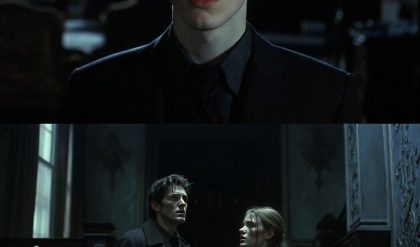
PART 2: THE MOMENT SHE REALIZED I WASN’T COMING BACK
I didn’t go far.
Just far enough that her voice couldn’t follow me through the walls.
The city outside our apartment looked unchanged that morning—people rushing, cars honking, coffee cups in hand like nothing inside anyone’s life had cracked open. That was the strange cruelty of it. Everything kept moving as if betrayal was just another private weather pattern no one else had to live through.
I sat in my car for a long time without starting the engine.
My phone vibrated once.
Clara.
Then again.
Then a message: Please come back. We need to talk.
We.
That word used to mean safety. Now it felt like denial dressed up as grammar.
I didn’t reply.
Instead, I opened something I hadn’t touched in months: a folder buried deep in my cloud storage. Not photos. Not memories.
Records.
Clara’s travel reimbursements that didn’t match her calendar. Late-night building access logs from her office tower. A recurring expense account tied to Daniel Vance that I had once assumed was corporate convenience. Small inconsistencies. Tiny fractures in a structure I had refused to inspect too closely.
I had always trusted logic over suspicion.
That was my second mistake.
By the time I finally drove back, it was afternoon. The apartment door was unlocked.
She was waiting in the living room.
Not crying now. Composed in that fragile, rehearsed way people use when they think control can still save them. Her hair was tied back again. Different clothes. Like changing outfits could reset reality.
“Ethan,” she said carefully. “Please sit down.”
I didn’t move.
“I broke things off,” she continued quickly. “With Daniel. It was a mistake. A moment of weakness. I told him it’s over.”
I looked at her for a long time. Not angry. Not loud. Just… empty of illusion.
“And if I hadn’t seen you,” I said quietly, “would it still be over?”
Her mouth opened. Closed.
That hesitation answered everything louder than words ever could.
“I didn’t mean for it to happen,” she whispered.
“No one ever does,” I replied.
Silence stretched between us. Not the comfortable kind we used to share at night with movies playing in the background and her head on my shoulder. This was different. This silence had structure. Finality.
She took a step toward me.
I stepped back.
That was when she understood.
Not the anger.
Not the suspicion.
The absence.
“You’re really leaving,” she said, almost as if testing the idea out loud.
“I already left last night,” I said.
Her eyes filled again, but this time she didn’t reach for me. She seemed to realize something she hadn’t considered before: that tears don’t rebuild what trust has already erased.
“I love you,” she said quickly, desperately, like a reflex.
I nodded once.
“I know,” I said. “But you stopped showing me that a long time ago.”
I placed a small envelope on the table between us.
She stared at it without touching it.
“What is that?”
“Everything we need to separate cleanly,” I said. “No fighting. No public mess. Just closure.”
Her voice broke. “You planned this?”
“No,” I said softly. “I observed it.”
That word landed heavier than anything else.
Observed.
Not reacted.
Not broken.
Just recorded.
I turned toward the door.
Behind me, I heard her finally cry—not the controlled kind from earlier, but something raw and collapsing, like a structure giving way under its own weight.
She said my name once more.
I stopped at the threshold, but I didn’t turn around.
Because if I did, I knew I might remember the man who used to forgive too easily.
And I couldn’t afford him anymore.
The door closed behind me.
This time, I didn’t hesitate.
And somewhere in the apartment I was leaving behind, Clara Doyle finally understood a truth she had never seen coming:
Some people don’t explode when they’re betrayed.
They simply stop returning.