Part 3
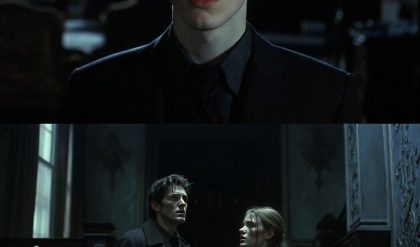
By the third week, Ravensmere no longer felt like a mansion. It felt like a battlefield where no one admitted the war had begun. Elena learned the patterns of Owen’s silence, the way he turned his face toward the window whenever pain became too sharp to disguise, the way he refused medication not out of strength but out of control. And Owen, despite himself, began noticing things he did not want to notice: that she never flinched when he coughed until his ribs shook, that she did not speak to him like a dying man, and that she never once mentioned the money unless Conrad brought it up first. One evening, as thunder rolled across the Hudson, Owen finally asked her, “Why are you really here?” Elena did not look away. “Because I know what it is to be counted as a cost instead of a person.” The answer should have ended the conversation. Instead, it made Owen sit up straighter. For the first time, he told her about the clinical trial he had secretly refused, about the truth his father never said aloud: that Owen was not only dying, but running out of time faster than anyone admitted. Elena listened. Not like staff. Not like a hired presence. Like someone who understood that some truths were heavier than death itself. The turning point came unexpectedly. Owen collapsed during a storm evacuation when the power failed. The backup system failed for seventeen minutes. Seventeen minutes during which Elena carried him down two flights of stairs while security argued over protocol. Seventeen minutes during which Owen, half-conscious, whispered something he had never said to anyone before: “Don’t let him turn me into an investment.” And Elena answered, “Then stop acting like one.” After that night, something shifted between them—not romance, not yet, but recognition. Two people who had both been bought in different ways refusing, for the first time, to stay owned. When Conrad learned what happened, he did not thank her. He changed the terms again. This time, not money—but control. Full medical authority transferred to Elena for thirty days. Owen heard about it and shattered a glass against the wall. “You’re not my nurse,” he said when she walked in. Elena looked at the broken glass, then at him. “No,” she said quietly. “I think I’m the only person here your father can’t replace.” And for the first time, Owen did not tell her to leave. Instead, he asked her to stay.
Final Part 4
The last month did not save Owen Whitmore in the way his father had once imagined. It did something far more dangerous—it made him want to live for reasons that had nothing to do with obligation. Elena stopped the estate from feeling like a cage simply by refusing to behave like a captive. She walked with Owen into the garden when he could breathe. She argued with doctors when she had to. And she told him the truth when no one else dared: that survival without dignity was just another form of dying slowly. Conrad Whitmore watched everything from a distance, his empire unable to solve what money could not stabilize. One morning, he finally admitted what Elena had already understood. “He listens to you,” Conrad said. Elena replied, “No. He finally hears himself.” The real collapse came not from Owen’s illness, but from the release of a hidden document Conrad never intended to be seen: a trust revision that revealed Owen was not just heir to the Whitmore fortune—he was its only condition of continuation. If he died unwilling, the empire fractured. If he lived on his terms, it survived intact. Suddenly, Owen understood the truth of his entire life: even his survival had been monetized. That night, he tried to leave the estate for the first time in months. Not to escape—but to choose. Elena found him at the gate, standing in the rain again, just like the night she arrived. “Where are you going?” she asked. Owen smiled faintly. “Somewhere I don’t belong to anyone.” Elena stepped closer, not stopping him. “Then don’t die belonging to them either.” The silence that followed was not heavy this time. It was free. In the end, Owen did not recover in the traditional sense. But he changed. He rewrote his medical authority, dissolved the conditional trust structure, and forced Conrad Whitmore to accept something he had never accepted in his life: choice without leverage. Months later, when the estate was no longer a place of control but of recovery, Owen stood in the same room where he had first told Elena to leave. He no longer needed oxygen support full-time. He no longer spoke like a man already gone. And Elena, holding a folder of signed legal documents, prepared to leave quietly as she had arrived. “You’re leaving?” Owen asked. Elena nodded. “The contract is over.” Owen shook his head. “No,” he said softly. “That was never the contract.” He stepped closer, no longer fragile in the way he used to be. “You asked for something money can’t buy,” he said. Elena frowned slightly. “What?” Owen looked at her for a long moment. “A person who chooses to stay when they’re free to leave.” Outside, the Hudson River moved under a quiet sky. Inside, for the first time, nothing in the Whitmore estate was for sale. And Elena Hart—who had once been purchased like a solution—finally understood she had never been part of a deal at all. She had been the beginning of its end.